
How to Run a Prior-Art Search with an AI Agent
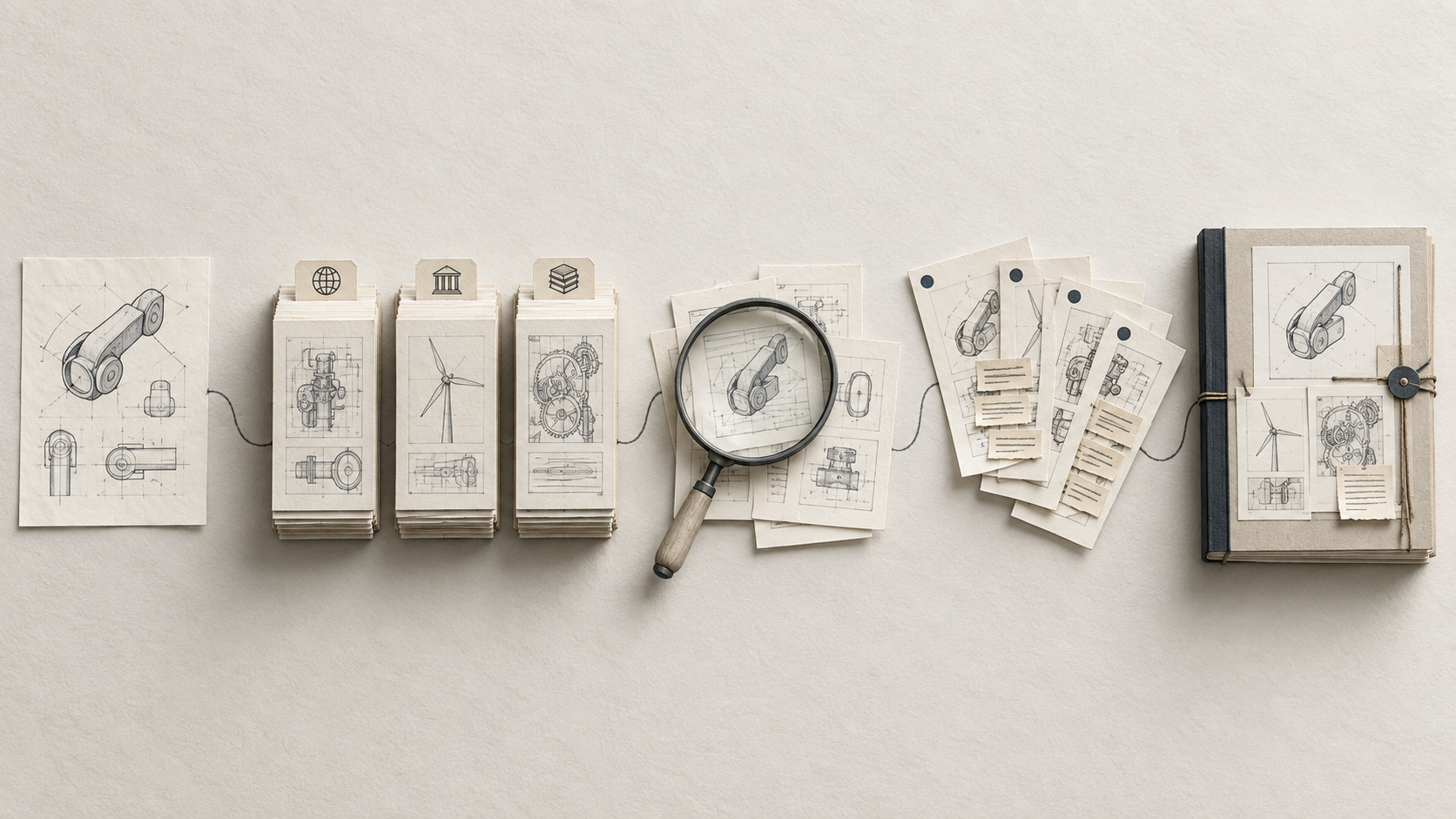
A prior-art search answers one question before it is answered for you: does something identical, or close enough to be obvious, already exist in the public record? Done before filing, it shapes your claims. Done during prosecution, it tells you what you need to distinguish. Done at the request of a client evaluating a competitor's portfolio, it anchors a freedom-to-operate analysis. The context changes; the task does not: systematic retrieval, careful reading, and documented judgment.
Prior art is the full body of information publicly available before your effective filing date. Under 35 U.S.C. § 102(a)(1), a claimed invention is unpatentable if, before the effective filing date, it was patented, described in a printed publication, in public use, on sale, or otherwise available to the public. The search also feeds the obviousness analysis: under 35 U.S.C. § 103, a patent cannot be obtained if the differences between the claimed invention and the prior art would have been obvious before the effective filing date to a person having ordinary skill in the relevant art. Both tests draw on the same pool of references, so a well-run search covers both at once.
One practical note before you start: under 35 U.S.C. § 102(b)(1), a disclosure made within the statutory grace period before the effective filing date is not prior art if the inventor or a joint inventor made it, or if someone who obtained the subject matter from the inventor made it. Your client's own conference papers, preprints, or product demonstrations may fall outside the prior-art definition, but only if you identify them, document them, and apply the statutory criteria carefully.
Frame the Invention as a Search Question
The search cannot begin with a keyword. It begins with a precise description of what the invention does.
Open the application draft, or your notes from the inventor meeting, and answer these four questions:
- What is the core technical problem? Not the commercial problem, the engineering one. "A sensor array that measures X in environment Y by using method Z."
- What is the inventive approach? The specific combination of elements that produces the claimed result.
- What would a practitioner with ordinary skill call each component? Synonyms live here. A "flap" in one field is a "baffle" in another. "Aerosol," "mist," and "fine spray" describe the same physical phenomenon in different art units.
- What conventional solutions already exist, and how does this one differ? Knowing the standard approach tells you which classification subclasses to search first and what distinguishing language you will eventually need.
Write the answers in a short invention summary, no more than one or two paragraphs. What you are building is a search brief: a statement of what you are looking for and in what technical space. Everything else in the workflow keys off this document.
Choose Your Databases
No single database covers everything. A credible prior-art search draws on at least three sources.
USPTO Patent Public Search is the primary resource for the full corpus of U.S. granted patents and published applications. It supports Boolean queries, full-text search across claims and descriptions, and searching by Cooperative Patent Classification (CPC) or U.S. Patent Classification (USPC) codes. Use it for U.S. priority filings and as your baseline for domestic art.
WIPO PatentScope gives access to published international PCT applications in full text on the day of publication, as well as patent documents from participating national and regional offices. It supports keyword, IPC classification, and Markush structure searches across multiple languages. Use it when the technology has likely PCT-filed competitors or when you need European and Asian filings alongside U.S. documents.
Google Patents provides a broad aggregation with CPC navigation and semantic search across a large international corpus. Its patent family grouping deduplicates results so you see one representative per family rather than the same invention filed in eight national offices. It is particularly useful for an initial landscape sweep before you narrow into database-specific queries.
Non-patent literature matters as much as patents in many fields. A reference qualifies as a "printed publication" under 35 U.S.C. § 102 when it has been disseminated or otherwise made available to the extent that persons interested and ordinarily skilled in the subject matter or art, exercising reasonable diligence, can locate it; public accessibility is the touchstone, not the physical format of the document. Academic papers, conference proceedings, standards documents, product manuals, and archived websites all qualify. Google Scholar covers most technical fields broadly; IEEE Xplore, ACM Digital Library, PubMed, and SciFinder fill disciplinary gaps.
A note on classification: the Cooperative Patent Classification (CPC) system was initiated as a joint partnership between the USPTO and the EPO on October 25, 2010, harmonizing their existing classification systems and aligning with International Patent Classification (IPC) standards. Because both offices speak CPC, a classification search in USPTO Patent Public Search and one in PatentScope or Espacenet draw on the same controlled vocabulary. Learning the relevant CPC subclasses for your technology is the single highest-leverage investment in search quality you can make.
Build Your Query Strategy
With a search brief and a database list in hand, construct the first query.
Step 1: Extract keywords and synonyms. For each functional component in your invention summary, list every synonym, trade name, and related term you know. Then use an AI agent to extend the list. In FlowLeap, open a session with your draft claims loaded as context and ask the agent to generate a synonym table for each key claim element. Ask it to flag terms it recognizes from adjacent technical fields, and to note common claim language for the concept from similar technologies. The agent returns a structured list; you decide what is technically accurate and what belongs in the query.
Step 2: Identify CPC subclasses. Navigate the CPC hierarchy in USPTO Patent Public Search or in Google Patents' classification browser. For a mechanical or electromechanical invention, two or three CPC subgroups typically cover the core claim space. For method claims or software-adjacent technologies, expect more. A thorough prior art search must cover domestic patents, foreign patent documents, and nonpatent literature; a text search alone is rarely considered thorough, and combining text with classification searching is the normal expectation. Run classification-only searches first to calibrate your subclass selection before layering in keywords.
Step 3: Write and run the combined query. A combined query in USPTO Patent Public Search might look like:
(piezoelectric OR piezo OR PZT OR electrostrictive) AND (actuator OR transducer) AND (CPC/H10N30)
Run it. Check the result count. Several thousand results means the query is too broad; add a limiter or a more specific CPC group. A handful of results may mean your synonyms are incomplete or you are in the wrong subclass. A result set of roughly 50 to 200 references per query round is a workable starting point for sorting and reviewing.
Step 4: Feed results back to the agent and iterate. Export a set of the most relevant abstracts and paste them into your FlowLeap session. Ask the agent: "What technical terms appear across these documents that we are not yet capturing in our queries?" It will identify language patterns you overlook after staring at the same keyword list for an hour. Use the new terms to refine the next query. Run the revised query, review again, repeat until the top results stabilize without introducing anything new.
Run this process across all three databases. A key reference found in Google Patents should prompt a targeted CPC or assignee search in PatentScope and USPTO Patent Public Search for the same patent family and any PCT equivalents.
Read and Rank the Results
Once you have a shortlist of 20 to 40 references, the work shifts from database navigation to legal reading.
For each reference, ask three questions:
- Does it anticipate the independent claim? That requires every element of the claim to appear, either explicitly or inherently, in a single reference. If yes, you have a § 102 issue that will drive claim amendments.
- Could it combine with a second reference to render the claim obvious? That requires a reason to combine the two, but examiners routinely find one for art in related fields.
- Does it teach the core concept from a different field? That may be analogous art, usable in a § 103 rejection even if the reference is from a different industry. The test is whether the reference is reasonably pertinent to the problem the inventor faced.
Build a reference table as you read. Columns: reference identifier, publication date, key technical disclosure, claim elements it reads on, and your judgment (anticipates / relevant to obviousness / background only). Keep notes on what each reference does not show; that is the space your claims will need to occupy.
Document What You Found
A search that is not documented did not happen, professionally speaking.
Your search memo should include: the invention description used as the search brief, the databases queried, the exact queries run with their result counts before and after filtering, the references selected for review, and your assessment of each. Record dates for everything.
This documentation is not administrative overhead. Under 37 CFR 1.56, each inventor, attorney, or agent substantively involved in preparing or prosecuting a patent application has a duty to disclose all information known to that individual to be material to patentability. Information is material when it establishes, by itself or in combination with other information, a prima facie case of unpatentability, or when it refutes a position the applicant takes in opposing an unpatentability argument. The references you find in this search are candidates for your Information Disclosure Statement (IDS). A well-documented search makes that IDS straightforward to prepare; a poorly documented one creates reconstruction work and risk.
If you used an AI agent to generate query terms or help rank results, note that in the memo too. The memo documents your process, not just your conclusions.
Common Pitfalls
Searching only by keyword. A search that never touches CPC codes will miss references that use different terminology for the same technical concept. Classification is the fallback when language shifts across fields or across generations of technology.
Stopping after the first significant hit. Finding one reference that reads on the independent claim does not end the search. A second, closer reference may be three pages further into the results. The goal is the closest prior art, not any prior art.
Skipping non-patent literature. In biomedical, chemistry, and software fields especially, research is published in journals and conference proceedings well before the same inventors file applications. A paper posted to an academic repository before your client's filing date can anticipate a claim as effectively as a granted patent.
Not checking patent families. When you find a key reference, search for its complete patent family. The U.S. national phase entry may claim different scope than the PCT publication; the priority application may contain disclosure not present in later publications. Databases report one family member at a time unless you actively expand.
Recording nothing until after the search is complete. Reconstructing queries and result counts from memory is unreliable. Record your queries, result counts, and the date of each search session as you run them. Corrections are cheap when the session is open; they are expensive when the search is weeks behind you.
Wrapping Up
A prior-art search is a disciplined exercise in asking what the public record already knows about an idea. Framing the invention correctly, working across at least three databases, combining text search with classification, using an AI agent to expand synonyms and surface language patterns in results, and documenting everything along the way are the practices that make a search credible and defensible.
The patent claim you write after the search is only as strong as the art you found and consciously chose to distinguish. The search memo is the record that shows you did the work.